Marcus Burns is a first-year student at Brown University, where he is studying linguistics. He grew up exploring the woods around his home in Lyme, New Hampshire, and fell in love with the work of Robert Frost in middle school. He soon began writing his own poetry centered around themes such as our connection with nature, his mixed Vietnamese American identity, and daily life in Vermont and New Hampshire.
Marcus was named 2024 National Student Poet of the Northeast Region by Scholastic, Inc., in collaboration with the Institute of Museum and Library Sciences (IMLS) and was a state finalist in Poetry Out Loud. Marcus is the 2026 Vermont Youth Poet Laureate. Follow him on Instagram at @markersmaker

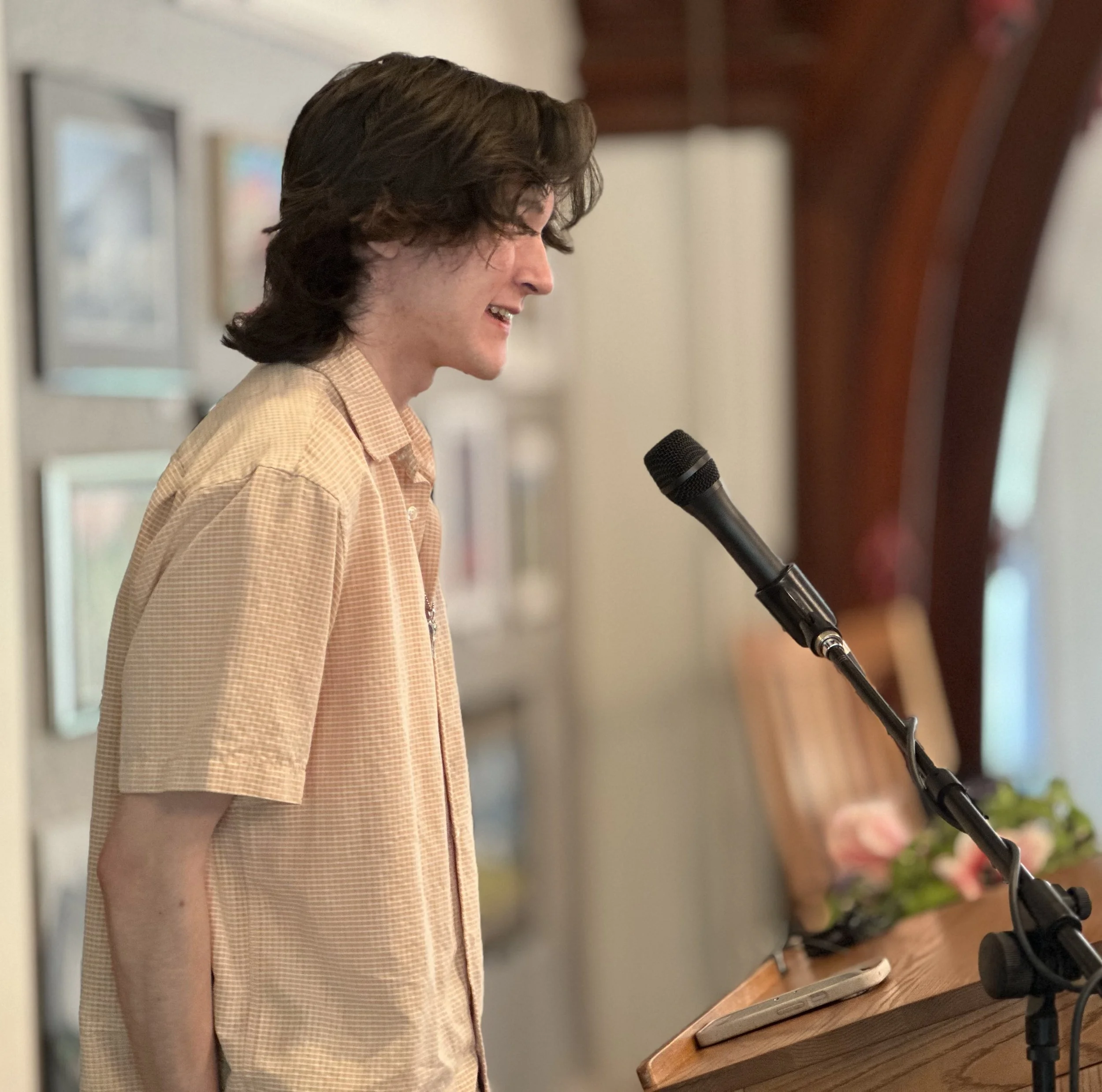
2026 Vermont Youth Poet Laureate Marcus Burns opens a Naturalization Ceremony at Rice Memorial High School with his poem “Yiping’s Asian Market.”
When did you start writing poetry?
Seventh grade. In middle school, we had a unit of Emily Dickinson, and then after that, we had Robert Frost. They inspired me… It’s more local. It’s like, oh, my home can be very beautiful, and I can write about it.
What are things you always seem to come back to when writing?
I really like dirt. I feel like a lot of stuff happens down there. Dirt, plants and animals, moss, trees, darkness.
I think about bones as other things, like shards, or pottery, or whistles, or human-made objects. And I think of darkness as something that connects people.
I also like to give my poems little taglines I say before I read them. My tagline for “New Moon” is about what I was thinking when I wrote it: at nighttime, everyone has the same shadow. So, in a way, we’re all kind of a part of this one big glob that is holding us all together.
Who are your biggest supporters in poetry, and who has encouraged you most in your writing?
My mom is very excited about the poetry I write. My teachers too. My creative writing teacher in high school was great. She really helped me, I wouldn’t have won any awards if it weren’t for her; she is the one who encouraged me to apply for the Youth Poet Laureate contest.
Also, my seventh-grade English teacher. They’re the person who inspired me to write in the first place.
Did you write before your poetry units in seventh grade? What were some of your other creative outlets?
I don’t think I wrote much before that seventh-grade unit. At least not on my own.
I discovered a lot of my creativity in middle school. I liked to draw a lot. That was my big thing. That and constructed languages. Which, looking back, may have primed me to be interested in poetry. I would make up little languages with their own systems and then scribble them in my notebooks.
What messages do you try to convey in your poetry? Does your meaning ever wander off while you are writing it?
I think the poem comes before understanding. The poem, when it takes on a life of its own, is what teaches me the point. And I would say there are some points I do keep coming back to, like things being cyclical and connected.
What is the best advice you have gotten?
There was a poem posted online with a comment saying that this person liked it but didn’t understand it. The next person commented: “Poetry isn’t really meant to be understood. You find the meaning, or you find your meaning because poetry makes you part of the creative process.”
I really liked that.
Poetry makes you part of the creative process. It can tell you to look at it from a different angle, and that you need to find that angle yourself.
What advice do you have for other young poets?
Poetry is not that scary. It’s fun. It’s not a terrible, frivolous artistic pursuit that is going to keep you from getting a job. Poetry is worth doing, and it’s worth giving your attention to.
Poetry is worth loving.